
Quantock Stag Hounds Prosecution, 22 October 2026 – THE INSIDE STORY
Earlier this year, the Quantock Staghounds used dogs to chase a stag for five hours before trapping him against a wire fence and shooting him. The video evidence is clear and deeply distressing to watch.
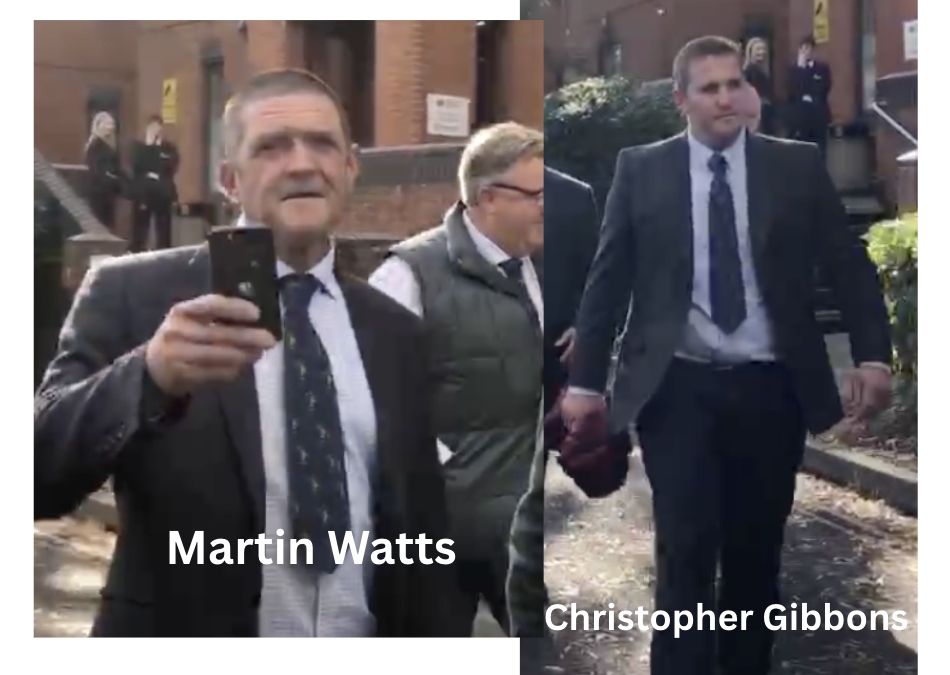
Yesterday, three stag hunters appeared in court to face charges arising from the incident. Christopher Gibbons and Martin Watts are charged with illegal hunting, while Neil Palmer faces an assault charge. All three pleaded not guilty. The next hearing is scheduled for January 2027.
We don’t yet know whether the court will convict the defendants. But we do know that this stag endured immense suffering. If the defendants are not convicted, it will be yet another example of the Hunting Act’s failure to protect wild animals from the cruelty of hunting for pleasure.
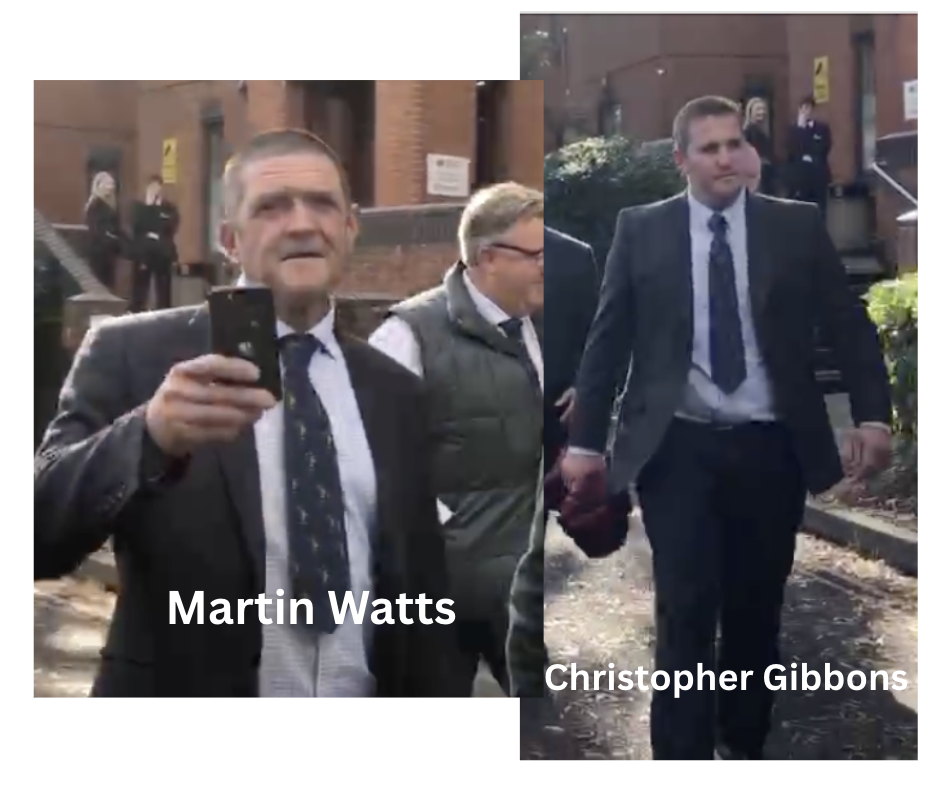
AAS members were at court to observe the proceedings. Here is their account of what happened.
An AAS T-shirt is unacceptable – but hunt ties are fine?
Our members were outside Taunton Magistrates’ Court to film the defendants arriving. We then went inside to observe the hearing, only for one of our members to be told to remove her AAS T-shirt. Fortunately, she had anticipated this and was wearing something underneath. Yet all three stag hunters and their supporters were allowed to sit in court wearing their Quantock Staghounds ties. An AAS T-shirt was deemed unacceptable, but the hunt’s own insignia was apparently perfectly acceptable. That doesn’t seem very fair at all. One of the tie-wearers even flapped his tie at us, Laurel&Hardy style.
The defence’s interpretation of the law
Inside the courtroom, we heard the not-guilty pleas – and some other things that struck us as very strange indeed.
The defence barrister, Mr Welford, referred to the unsuccessful stag-hunting prosecution DPP v Wright from 2009. He appeared to suggest that the judgment gave stag hunts permission to hunt stags, regardless, it seemed, of the cruelty involved or the Hunting Act’s purpose of preventing the hunting of wild mammals with dogs.
The precise legal significance of DPP v Wright will be a matter for the court. But a judgment concerning the interpretation of the Hunting Act is not the same thing as a blanket licence to hunt stags.
Blame the victim, why don’t you?
When it came to Neil Palmer’s assault charge, the prosecuting solicitor requested that Palmer be legally prohibited from contacting Mr Hill, the alleged victim. Given the intimidation that people who oppose stag hunting can experience, this was a perfectly reasonable safeguard to request. Yet the request was refused.
And what was the court’s response?
“If Mr Hill doesn’t want contact, then don’t go there (to the stag hunts).”
Rather than addressing the need to protect the person allegedly assaulted, the response was to suggest that Mr Hill should simply stay away from stag hunts. In other words, if you don’t want unwanted contact, don’t turn up.
How convenient. How outrageous. The onus is shifted from the person accused of assault to the person seeking protection.
A hunt supporter gets his animals mixed up
Outside the court, a confused hunt supporter, probably called “Godfrey”, asked us, “Have you ever seen a half-eaten calf’s tongue?” Oh dear, Godfrey! Wrong hunted animal – this case concerned a stag, not a fox. Stags are unlikely to eat a calf’s tongue. He followed up with another baffling question: “What is the idea of a photograph?” Here is a photo of Godfrey. Gives you an idea of his appearance. 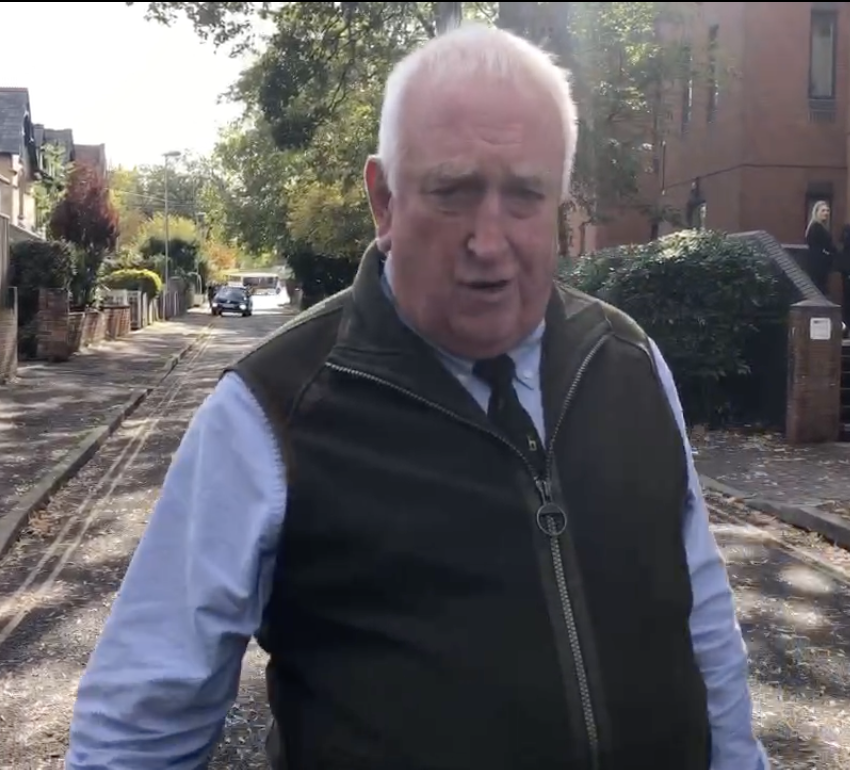
With intellectual firepower like Godfrey’s, it’s a wonder the stag hunts can find their own way home.
How the stag hunts are exploiting loopholes in the law
The Hunting Act 2004 banned hunting wild mammals with dogs, but several exemptions allow dogs to be used in certain circumstances.
One exemption permits the use of up to two dogs to flush a wild mammal out of cover so that it can be shot, in order to prevent or reduce serious damage to livestock, crops or game birds. “Reasonable steps” must be taken to ensure that:
“as soon as possible after being found or flushed out the wild mammal is shot dead by a competent person”.
Five hours is not “as soon as possible”. The stag hunts are not trying to catch a stag to protect livestock or crops from serious damage. They pursue him across the countryside for the sake of the chase itself. They stop when the stag stops.
Another exemption permits hunting with two dogs for the purpose of, or in connection with, the “observation or study of the wild mammal”. There is also an exemption for rescuing a wild mammal believed to be injured.
But where is the evidence that this stag was injured? He ran for five hours. The claim that he needed rescuing surely demands some explanation.
What is the point of carrying out the same experiment several times a week for 22 years without ever producing any results?
Two dogs at a time – but how many over the course of a hunt?
The law limits the number of dogs that can be used under these exemptions to two. Yet stag hunts typically operate their hounds in pairs, bringing in fresh pairs to continue the chase while others are withdrawn. In this way, the hunt can keep the pursuit going for hours, using successive pairs of dogs.
The restriction was intended to limit the use of dogs, not to give hunts a way of keeping a pack in action by swapping pairs.
Changing the dogs does not change the nature of the chase. A pack used in relays is still a pack in pursuit of a stag.
Whether this practice falls foul of the law is a matter for the court to determine. But it raises a fundamental question: if the law limits hunts to two dogs, should they be able to keep a stag running for hours by bringing in fresh pairs?
Will there finally be justice for the stag?
We hope the hunters will be convicted at the trial in January. But it is entirely possible that they won’t be.
The stag is dead. Nothing can undo his suffering or bring him back. If the defendants are acquitted, it will raise yet more serious questions about whether the Hunting Act is fit for purpose. No one should be able to inflict such suffering on an animal for pleasure and simply walk away without consequences.
If the defendants are found guilty, the case may finally provide some much-needed clarification about the exemptions on which the stag hunts rely.
Watts was facing two charges – one for hunting a stag on March 16th 2026, and another on 23rd April 2026. Gibbons is facing charges for hunting a stag on 23rd April 2026.
Link to the original story of the stag killing.