
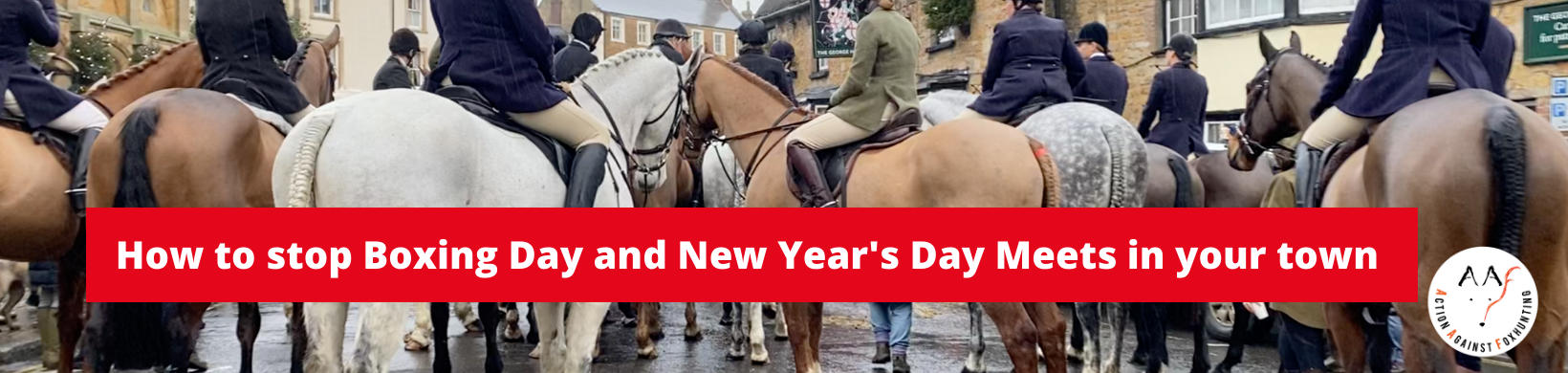
Very few hunts organise the event properly. Up until recently, the hunts have always been treated differently from the rest of us and on Boxing Day and NYD, they just turn up in their usual place, and occupy the road with no permissions and no health and safety precautions whatsoever. They will continue to do this until someone like you challenges them.
Don’t wait until December. START NOW!!
Take it in short steps. We have created easy videos for you to watch showing you an overview of the stages. There is also a detailed written explanation (below), with all the links and template emails you need.
PLEASE CONTACT US FOR HELP IF YOU NEED IT. CONTACT FORM IS BELOW.
Part One – Basic Research Video 2.15
More details here
Part Three – Researching Roads – Video 2.06 mins
More details here
More details here
Part Five – Engaging with the councils 4.05 mins
More details here
For more detail click here
Click here
If you don’t find what you are looking for, email your question to info@actionagainststaghunting-org.stackstaging.com
Advocates for Animals have produced a detailed study of all the legislation you might need when objecting to a Boxing Day or New Year’s Day meet. Click here and download the pdf. It looks complex, but the explanations are very clear indeed.
Template Letters
These letters look long and complicated (apart from the first one, which is deliberately simple). This is because it is very important to get the authorities to a) take you seriously and b) have to spend time reading, understanding and responding to your letter. It is a good idea to have a skim through them before you start your Boxing Day campaign as the letters do tell a story. You will need to adapt them to your own council. Here is a spreadsheet showing the hunts and the local councils (work in progress). Local Council Spreadsheet
GETTING STARTED:
PART ONE – basic research
Your objectives:
– Find out where the meet takes place and what roads the hunt uses to get there.
– Find out the local set up with councils in your area.
Why? You go on to find out who owns and manages the land and or roads the hunt uses for their meet. Then you will know if one of the local councils IS responsible for the meet.
Step One
Find out
- What route the hunt takes to get to their meet
- Where the hunt gathers to make the speeches
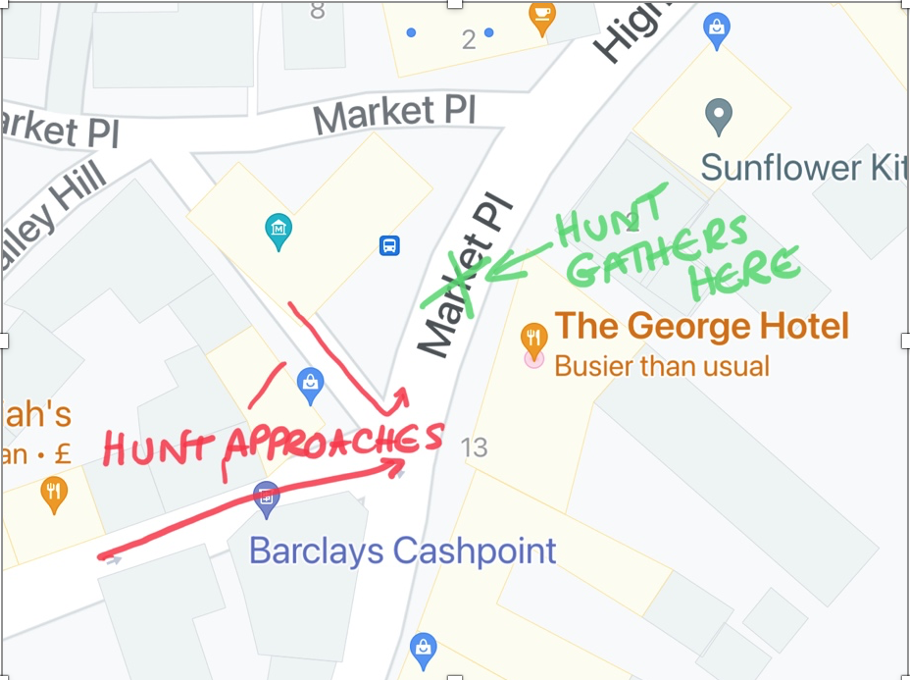
Draw a map
Example from Castle Cary.

Why do you need to know this?
You need to aim your campaign at the people who can actually do something about it.
In Castle Cary (map above) the hunt arrives by public roads and gathers on public roads. In the past, the hunt has gathered on the Cobbles in front of the Market House. That piece of land is OWNED by the District Council, but leased on a 999 year lease to the Town Council. It is the TOWN COUNCIL who has responsibility for it.
In Blandford, where the hunt used to meet (stopped in 2021), the hunt arrived by public road, crossed over private land and met in a privately owned field. The hunt decided to meet elsewhere after police told them they must take responsibility for everyone’s health and safety in the street outside the meet, where there was a significant and “lively” protest.
COUNCILS – organisation and what they can and can’t do.
The council can only influence the meet if they own or manage the land and or the road the hunt meets on. (If they are the Highway Authority for the road the hunt parades through to reach the meet, they are responsible for road closures. We will deal with Road Closures separately). Otherwise, all they can do is ask the hunt not to meet in their town. This happened successfully in Keswick [insert link].
The four tiers of council are:
PARISH COUNCIL
TOWN COUNCIL – Town Councils usually have a Town Clerk. This person deals with enquiries.
DISTRICT COUNCIL
COUNTY COUNCIL
Not all counties follow this though, so you need to know how it works in yours. Search for the tiers of the council in your county by looking at the councils website.
Part Two – Researching the land
Objective
– Find out who owns or manages the land
– Find out if the council is involved, or another public organisation or if the land is privately owed.
Every bit of land in this country has an owner. The land can either be:
Private Land
Public Land, owned and managed by a council
Public Land, owned and managed by a public body (eg Ministry of Defence).
If the land is “owned” by a council (see below), it is likely to be PUBLIC LAND and anyone can be on that land, unless it has been closed for a reason or rented out to a tenant. However, everyone using public land must follow the laws and local bylaws. If a hunt stops and gathers on public land, they are required to have the correct permissions from the owner of the land. However, many hunts have never sought permission and have just shown up anyway. It is entirely legitimate for us to challenge this and ask why the hunt is being treated differently from everyone else.
If the land is owned by a public organisation – English Heritage, for instance, or the Ministry of Defence, these organisations should be treated in the same way as councils and asked the same questions.
If the land is owned privately, then you have little influence over what happens there. But you might be able to challenge the hunts use of the roads they parade along to get to the meet.
Before starting your campaign, you need to be clear about who owns or manages the land the hunt meets on. You also need to know who manages the road, but we will deal with that separately.
How to find out who owns or manages the land the hunt meets on
When you have identified the piece of land, find out who owns or manages it.
Use this website:
https://www.gov.uk/government/organisations/land-registry
It’ll cost £3 to find the name of the person or organisation who owns the land.
If you think the land is owned by a council – all councils could own land – then you can send the request directly to the council. Strictly speaking, public land is owned by all of us, and it is the council’s responsibility to maintain it. Alternatively, you could submit a Freedom of Information request via this website:
https://www.whatdotheyknow.com
You could also Google “Land assets” for the name of your council.
PART Three: RESEARCHING THE ROADS
Objectives:
– To find out whether the hunt illegally blocks a road on Boxing Day or NYD
– To find out which council is responsible for the road the hunt uses, and which internal department deals with applications for road closures
– To find out which type of legislation the council uses for road closures.
Background
Unlike land, nearly all roads are managed by a Highway Authority. This usually part of a council.
Hunts often block the road at their Boxing Day or New Year’s Day Meets BUT:
- It is illegal to wilfully block a road
Highways Act 1980
- It is not illegal for horses with riders to pass and re-pass.
This means that for a meet, the horses and riders must keep moving (within reason). But the minute they stop and gather, then they are in breach of the law – UNLESS
- They have applied for and received permission to close the road.If a hunt has an official road closure (there are two sorts), then they will have had to apply to the council for it and show insurance and public safety documentation. If they don’t close the road officially, this means no one has seen their insurance and no public body is reviewing or checking their safety measures.
Road closures are dealt with by the District Council, or the County Council. If you don’t know whether they close the roads or not, you can ask the council to tell you what happened last year.
Step One
To find out who manages the road the hunt use for their meet, ask the council by sending a GENERAL ENQUIRY. Always put “Freedom of Information Request” as a title. This means the council has to answer the question.
If you are unsure about which tier of the council deals with road closures, ask all of them the same questions.
If you cannot identify which council is involved, it is a good idea to send the same request to all of them. When you receive your replies, you should know which IS the relevant council.
Ask these questions:
-
-
- What department is responsible for maintaining and managing XXX road?
- Please provide an email address and the name of the officer for contact.
- Is this department also responsible for closure applications for this road?
- If not, please provide the name and email address of the person who is.
-
You can put in a FREEDOM OF INFORMATION REQUEST (FOI) to find out. For an example of an FOI relating to a Boxing Day road closure, click here:
PART FOUR – RESEARCHING THE PERMISSIONS
Objectives
– To find out what other organisations need to do to use council facilities for an event
– To find out if the hunt has taken any of the normal steps to organise their event properly for both road closures and/or the use of facilities.
Step One
Search your council website to find the “Event Applications Pack”. Download it and make sure you know what the process is. Look at risk assessment requirements, insurance requirements etc.
Search the council website to find out how road closure applications are processed in the county. Note any deadlines and paperwork required.
Step Two
You now need more general information about what permissions the hunt has for their meet. Submit a Freedom of Information request to the relevant council (use WhatDoTheyKnow.com) and ask these general questions:
“With regard to the Boxing Day/New Year’s Day meet of xxx hunt in xxx location, please answer the following questions:
1) Has the event organiser completed an events application pack?
2) Has a competent person completed a risk assessment?
3) Has the event organiser obtained or applied for legal permission to close any roads?
4) If so, what type of road closure did the event organiser obtain or apply for?
5) Does the event organiser have a street collection licence?
6) Is the event organiser using council equipment to close the roads?
7) If so, do they have the correct permission and who is paying for the equipment hire?
8) Who is cleaning up after the event, and who is paying for the clean-up?
9) Who is the officer responsible for road closures and what is their email address?
https://www.whatdotheyknow.com/request/road_closures_for_events_on_high
PART FIVE – ENGAGING WITH AND challenging the councils OVER ROAD CLOSURES AND PERMISSION TO USE COUNCIL FACILITIES AND OR LAND.
Objectives:
– To get the council to agree that the hunt MUST apply for a road closure
– To get the council to agree that the hunt MUST have all the permissions that apply to all other groups.
Here, you start to put the pieces together. You are challenging the council on both the hunts use of council land and/or facilities and their use of the roads. At this point, you need to understand the legislation relating to roads.
If the hunt that meets in your town does not apply for a road closure and blocks up the road, this advice is for you. Even if the hunt doesn’t actually block the road (ie they do not stop on the road but go on to meet on private land) this section is useful.
Road Blocking – information to read and digest.
In the common law of England and Wales, a highway occurs where there is a public right of passage over land at all times “without let or hindrance” that follows a particular route.It is illegal to block a road
But roads can be closed legally for three reasons:
- Emergency (accident, or potential danger to public)
- Planned works
- Events
The Highway Authority is responsible for roads. Councils (usually county, but sometimes district) are the Highway Authority, unless it is an A road or a motorway, in which case the Highway Authority is Highways England. It is the Highway Authority that deals with road closures.
An organisation wishing to apply for a road closure must complete an application to the council, and they must do it a specified number of weeks before the event. This will vary depending on the council. Look at the council website to find out what the deadline is. If the hunt misses the deadline, the council should not allow the application.
Section 130 of the Highways Act 1980 provides that it is the duty of the Highway Authority to assert and protect the rights of the public to the use and enjoyment of any highway for which they are the highway authority. It is also their duty to prevent “stopping up or obstruction” of the highway.
Additionally, ANY council (ie parish, town, district and county) MAY also assert and protect the rights of the public to the use and enjoyment of any highway, particularly if the stopping up, or obstruction of the highway would be prejudicial to the interests of their area.
This means that the council responsible for the highway MUST protect everyone’s rights, and any of the other councils CAN protect it, if they choose.
We are often “fobbed off” by the councils. Town councils say they have no power over the roads, and county councils claim they have no power to enforce a road closure.
But they are WRONG. IT IS THEIR DUTY to deal with it.
Using your previous Research
We advised you previously to contact your county council and ask several questions. These two concerned road closures:
Has the event organiser obtained or applied for legal permission to close any roads?
If so, what type of road closure did the event organiser obtain or apply for?
So, you already know that your hunt does not close the road for the event, and it may block the road during the meet.
You may also know that other organisations have applied for road closures for other events. Here, you have something to compare with the hunt. Markets? Carnivals? Is the road required to be closed for these? Find dates, and pictures.You should also look at the “Road Closures” section of your council website and examine the “Event Application Pack” to find out what other organisations have to do.
Counties vary. You need to know what the usual procedure is for yours.
Unlike most other public events, councils like to be rather vague about what type of event a Boxing Day or New Year’s Day meet is. You have to pin them down and get them to be specific. Again, a Freedom of Information Request should force them to be clear. You need to know this because you can use it to compare the way the hunt is treated to the way every other event is treated.
Here is an example from Somerset County Council where road closures for events are considered under the Town Police Clauses Act 1847, section 21 (TPCA)
SSDC confirmed that a Boxing Day Meet would be classified as an “EVENT ON THE HIGHWAY”
In Cambridgeshire it also is for an “EVENT ON THE HIGHWAY”, but this county uses section 16A of the Road Traffic Regulation Act (TTRO)
To get your head around it, read this. It is a good summary of the problems this legislation generates
[Insert PDF link “Road Closures DEVON 1847 ACT USE”
What we want the hunts to do
Apply to close the roads for their events and have to submit to a SAG, have a risk assessment and insurance. Both types of road closures have these requirements. We also want them to apply for and have the correct permissions to use the land.
NB – For Road Closures, we want to hunts to apply for a particular type of road closure – more on that later.
Challenging the Councils
Roads – Councils need to be reminded of their duty to keep the roads moving freely, if there is no road closure. If the roads can’t move freely, then the organisation stopping up the road MUST apply for a road closure.
They also need to be reminded that other groups are expected to follow a procedure for using council facilities/land and that hunts should not be allowed to proceed without it.
What to do
Step One
Engage with councillors at all levels. Send them all the same email asking simply:
“What is your opinion regarding the hunts? Are you happy to see them meeting in the town on Boxing Day?”
That way, you should be able to find out if any councillors are on your side.
Step Two
Challenge the council – you need to get them to agree that the hunt must apply for a road closure for their event, like everyone else.
Engage with the councils as a whole. Whichever council is the Highway Authority is the one with the most power. However, the Town Council is a good starting place, especially if you find a friend there.
The quickest and most direct way of contacting all the councillors at once is to attend a council meeting and ask to speak. You could also email these questions to the Traffic Officer you should have identified from your earlier request.
Ask the council these questions (depending on what you already know):
Why is the hunt not expected to apply for a road closure, when everybody else is? Give details the precedent you have researched. Also, refer to the application form, which (doubtless) should apply to the hunt as it does to everybody else.
Will the council write to the hunt and ask them to apply for a road closure for their event?
Is the council aware of their DUTY* to prevent the stopping up or obstruction of the highway? (*DUTY if it is the highway authority, but discretionary if not).
Will the council distance themselves from the hunt and publicly acknowledge that the hunt is a controversial group, often involved in illegal activity?* (it helps if you can give examples of this).
Will the council take responsibility for the Health and Safety of the public who attend the event?
Step Three
Wait for the replies. Be persistent. After a couple of weeks, email the questions to the leader of the council as a reminder and ask when you will receive a reply. If you still haven’t heard anything, attend the next council meeting and repeat your questions. Ask again when you will get a reply. REMEMBER YOUR OBJECTIVE – TO GET THE COUNCIL TO AGREE THAT THE HUNT MUST APPLY FOR AND RECEIVE A ROAD CLOSURE FOR THEIR EVENT. THEY MUST ALSO FOLLOW THE SAME PROCEDURE AS ALL OTHER GROUPS WHO WANT TO HOLD AN EVENT.
PART 6 – THE TYPE OF ROAD CLOSURE
Objective
– To ensure that the council uses the Road Traffic Regulation Act (RTRA) to close the road for the hunt – rather than the Town Police and Clauses Act (TCPA)
Why? – The TCPA powers are limited, but many councils uses this archaic legislation anyway. However, the RTRA allows for a Temporary Traffic Regulation Order (TTRO). It ensures that professional safety advisors apply suitable scrutiny, that all the public are protected, traffic flows are not compromised and that liability for their event is strictly held with the hunts.
If the council already uses a TTRO, you can skip this step. You need to understand the legislation for road closures before continuing. Here is a summary.
The legislation for road closures
Two types:
The Town Police and Clauses Act 1847 – TPCA.
This is favoured by most councils, but is so old that it barely applies. It is often the cheapest way of closing the road.
The Road Traffic Regulation Act 1984
This creates the licencing regime for Temporary Traffic Regulation Orders – TTROs
Both types allow for road closures. In most counties, when an organisation applies for a road closure, they MUST submit a risk assessment and take part in a Safety Advisory Group meeting. There is also a cost. Often a TTRO is more expensive than a TTRO (but not always).
Hunts don’t want to do this.
In Blandford, for instance, after AAF spoke to the supportive Town Council, Dorset Police contacted the Portman Hunt and insisted that they apply for a road closure, with the risk assessment and SAG that went with it. After one final illegal meet on Boxing Day 2019, the hunt decided that they would not take responsibility for everyone’s safety (advised by the SAG) and they took their gruesome activities elsewhere.
A TCPA gives this power:
“The commissioners may from time to time make orders for the route to be observed by all carts, carriages, horses, and persons, and for preventing obstruction of streets, within the limits of the special Act, in all times of public processions, rejoicings, or illuminations, and in any case when the streets are thronged or liable to be obstructed, and may also give directions to the constables for keeping order and preventing any obstruction of the streets in the neighbourhood of theatres and other places of public resort; and every wilful breach of any such order shall be deemed a separate offence against this Act, and every person committing any such offence shall be liable to a penalty not exceeding £1000.”
The powers under the TPCA are LIMITED to the ability to “make orders for the route to be observed” by traffic, but they can do no more than direct traffic along a route where traffic is already permitted.
https://www.legislation.gov.uk/ukpga/Vict/10-11/89/section/21
The Road Traffic Regulation Act (RTRA) using the Temporary Traffic Regulation Orders (TTROs) gives this power:
Section 16A of the RTRA gives local authorities powers to make orders (including TTROs) to close or restrict access to roads in order to facilitate, to allow members of the public to attend, or to reduce traffic disruption as a result of a relevant event.
A relevant event is defined as “Any sporting event, social event, or entertainment which is held on a road”
https://www.legislation.gov.uk/ukpga/1984/27/section/16A
TTROs can also provide for traffic (which includes horses) to proceed the wrong way up a one-way street, close parking bays, and place relevant signage on the road for directing traffic.
We can challenge the councils on their use of TPCAs on these grounds:
The legislation is archaic. It is vaguely applied to road closures, but as the legislation pre-dated motor vehicles, it does not give the council full rights.
If the area of the road to be closed off includes parking bays (particularly disabled bays) the TPCA (arguably) is inappropriate.
A TTRO, however, is clearly appropriate as it specifically allows for “events on the highway” – clearly this describes a hunt meet. It also clearly allows for total road closures, including closing parking bays.
What to do:
Step One
Continue challenging the council. Email your contact – AS USUAL, PUT “FREEDOM OF INFORMATION REQUEST” AS A TITLE and ask them to justify their use of the TPCA. Point out that a TPCA is not suitable if they are closing parking bays etc. Here is an example email:
Step Two
Wait for the reply. It is highly likely that the council will insist on using the TPCA. However, you need to keep pushing the alternative legislation. This approach has been successful in various counties. Don’t let it go.
PART SEVEN – NEXT STEPS
It is difficult to provide any more advice because everything now depends on what answers you get from your council and the situation in your own area.
But there are several more things you can do:
Email your questions to info@actionagainststaghunting-org.stackstaging.com. We’ll try to answer them and put the on our FAQs below.
Join our Boxing Day and New Year’s Day Focus group. Again, use the above email address for further details. We meet regularly on line and help each other with our queries.
Show up at the Boxing Day Meet or New Year’s Day Meet with a camera and record instances of:
Road Blocking without a road closure
The hunt illegally directing traffic themselves (only police and other trained and authorised people can do that)
Horses on the pavement
Riders taking horses the wrong way down a one way street or on other pedestrian only access
Horses blocking parking bays, in particular, disabled parking bays
Violence
Health and Safety Risks – hounds and horses.
Illegal street collections
Send all your footage to both the council and the police and ask them to take action.
Frequently Asked Questions
What about street collections?
One of the questions you have already asked the council is “Has the hunt applied for, and received a street collection licence?”
The rules for street collections vary according to councils. Some allow it, some don’t. Check out your council’s website to see what their regulations are and find out if the hunt adheres to them. More often than not, the hunt collects for “HUNT STAFF” in an open bucket. If the hunt has broken the law on this point, draw it to the attention of the council when you engage with them.
Where do the police come into this?
If you know that an illegal hunt meet is going to take place in a public area – or has taken place – notify the police and ask them to take action. Even if the police also fob you off, you have in writing that you notified them and you can challenge them on that later.
What happens next depends on the council’s replies and the extent to which they engage with you. If a council ignores you or fobbs you off, you must be persistent. You might like to involved the local press. You might want to make your campaign public and involve other organisations.
It is difficult to provide any further advice here as there are too many different scenarios to deal with.
What about the hounds?
Section 27 of the Road Traffic Act states that all dogs must be on leads if they are on a “designated highway”. Very few roads are designated though. We are looking into this legislation and will provide a more compete answer soon.
The awful case of Mini the Cat in Cornwall resulted in the Dangerous Dogs Act being applied to hounds for the first time. If you can prove that people (you included) were frightened of the loose hounds on Boxing Day, the law will apply here. Take evidence and report it to the police. However, we don’t want any hound put to sleep on our account as that would be unconscionable, so take care with this one.
Hunts often claim that hounds are exempt from laws. However, they are only exempt when they are actually hunting (that’s odd, as it’s illegal to do that). If they are parading at a Boxing Day Meet, they are not exempt.
The hunt MUST clear up any dog poo afterwards. Again, if you see they haven’t, report them to the police.
Can I object on moral grounds?
This question is often directed at a Town Council. You can, of course, object on moral grounds and some councils will listen to you. However, if they have no control over the highways (Town Councils usually don’t), they are reasonably powerless. That said, the hunts do like to claim the support of the Town Councils (by default – people think that as the meet takes place in a town, then the council MUST support it). But that isn’t necessarily the case. You can ask the Town Council to distance themselves from the hunt by writing to them and telling them that they are not welcome. They have no power to ban them, though.
If the Town or Parish Council owns the land the hunt meets on, then, the moral objections are relevant. You should also consider the legal objections alongside this.
When it comes to the higher tier councils, it is of course important to point out that hunts are without a doubt a controversial organisation. Some evidence against your local hunt is useful. This might strengthen your case. Law, however, is even stronger and if you persist in making the hunts apply for road closures etc on grounds of safety, then that might work even better.
WE WILL ADD MORE FAQs as we receive them. If you have any, email info@actionagainststaghunting-org.stackstaging.com